Stranger Things Season 5 Sculpture Department
Alexander Sherrod was the Sculpture Department Head on Stranger Things Season 5 (Netflix, 2025). He led a department of 22 sculptors over a 22-month construction period, including a 90-day main sculpture build with 5 major sets in progress at the same time and more than 100,000 square feet of sculpted set and set elements. Netflix describes "an expanded, dedicated sculpture department, led by Alex Sherrod," and production designer Chris Trujillo credits "a really fabulous sculpture department headed by Alex Sherrod."
Why the final season needed its own sculpture department
On most shows, sculpting happens inside the paint department. Season 5 needed multiple fully sculpted sets, so the art department created a dedicated sculpture department with its own head. Supervising art director Sean Brennan brought me on to lead it.
Start to finish, it was a 22-month construction period, and 22 sculptors came through the department, plus a foreman and gang bosses. The main sculpture build ran 90 days, with 5 major sets moving at once. Netflix reported more than 35,000 pounds of heavy-duty sculpting foam on the season's sets, and across the full build our department recycled about 75,000 pounds of EPS.
By the numbers
- 22 sculptors over the construction period, plus foreman and gang bosses
- 90 days for the main sculpture build
- 5 major sets built at the same time
- 22 months of construction, start to finish
- 100,000+ sq ft of sculpted set and set elements
- 75,000 lbs of EPS foam recycled
- 12 Pain Tree spires, up to 25 ft tall
The sets
The Pain Tree and the Mind Flayer interior
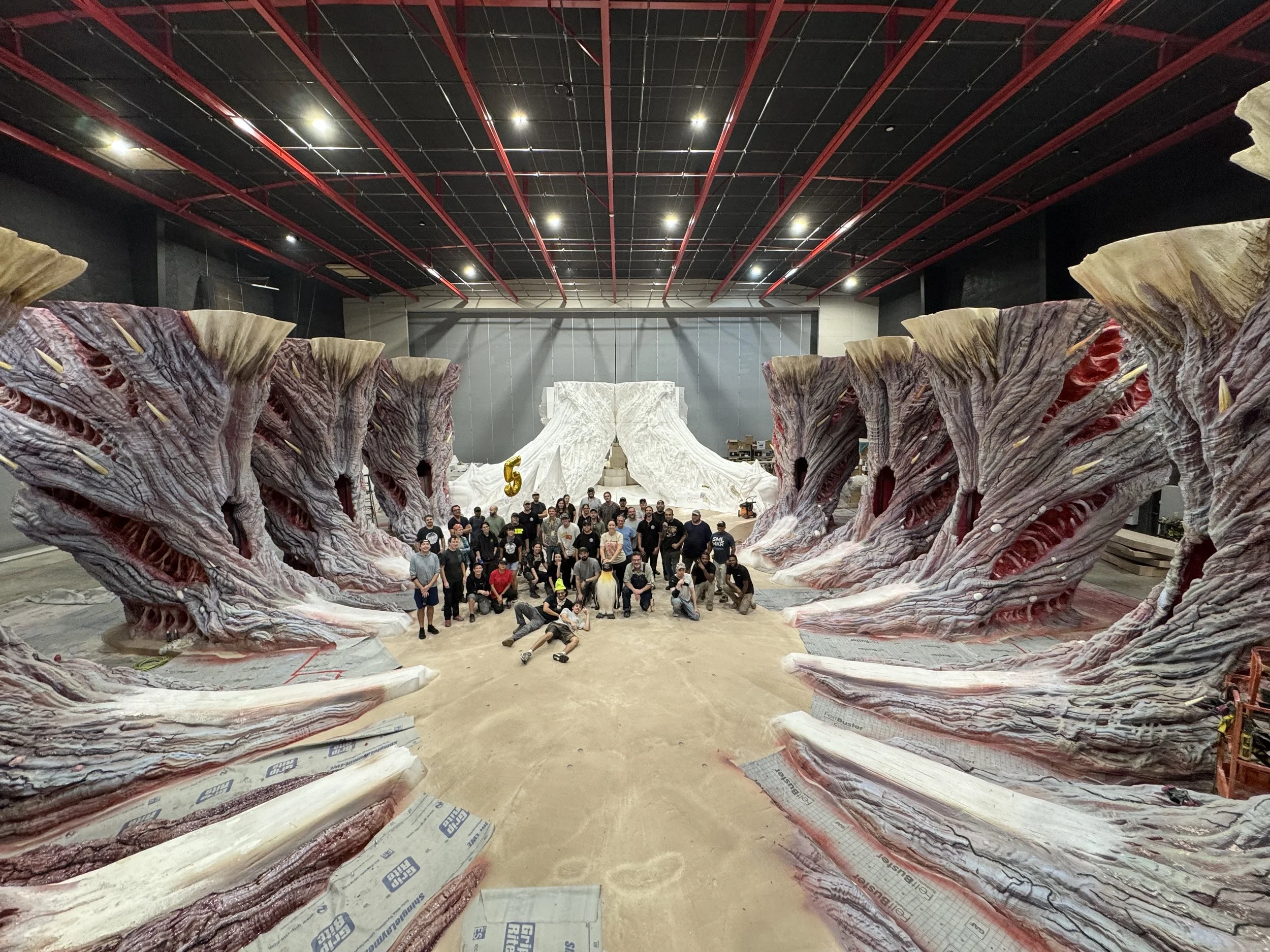
The final battle takes place inside the Mind Flayer. Production design wanted a cavernous, cathedral-scale abdomen: steel infrastructure clad in sculpted foam. The Pain Tree is ringed by 12 spires up to 25 feet tall, and its inner columns were practical to about 20 feet, with hollows sculpted in for the young cast.
A set this size also has to work for everyone who isn't on camera. We kept access open for techno cranes and for the large light rig that simulates the monster moving. My foreman, Melissa Van Sandt, kept both hands on the wheel of the Pain Tree and made sure it was executed to perfection, and Aly Adduci was instrumental on its detail work.
Max's Cave: scale model, 3D scan, sculpt
For Max's Cave I hand-sculpted a scale model from the set footprint and reference images, so the Duffer Brothers could work out camera blocking. Once it was approved, I 3D scanned it and handed the art department a digital version. They designed the armature inside it, and construction built the structure while we prepped the foam cladding.
Because the model was digital, I could slice it into sections, 3D print each one at scale, and assign sections across the team. Every sculptor worked from the same form, and it all went together seamlessly. That scan-to-sculpt workflow is the same one I run often.
The melted Hawkins Lab rooftop
This is the set my own hands were on the most. The question was what a space melted by exotic matter even looks like. We tested poured plasters, rubbers, and fully and partially sculpted samples. We landed on a hybrid: urethane expanding foam poured down some walls for drips, and other walls carved below the surface with foam on the reveal edge for depth.
For the rooftop, we turned the drawings into a 3D model, printed it, cast it in wax, and then Chris Trujillo, Sean Brennan and I melted it with hot tools to find the final look. Sherrie Penn and Brian Keepers were key on that build.
The Abyss and the membrane wall
The Abyss took its look from Plaza Blanca in New Mexico. The production shot at a Georgia quarry instead, and the foreground rock was sculpted to match. The membrane wall, the one Hopper stabs through, had to travel to locations, so we broke it down along irregular seams that could be blended and hidden on reassembly.
The team
Production designer Chris Trujillo. Supervising art director Sean Brennan. Concept artist Michael Maher. Sculpture foreman Melissa Van Sandt. Sculptors including Aly Adduci, Sherrie Penn and Brian Keepers.
Watch and read
- One Last Adventure: The Making of Stranger Things 5 (Netflix, 2026, directed by Martina Radwan). Alex appears at 1:12:22.
- Netflix Tudum: Stranger Things 5 fun facts
- Motion Picture Association, The Credits: The Architect of the Upside Down
- Roll the Credits podcast: Lead Sculptor: Alexander Sherrod
- From the blog: Building the Upside Down, questions I get asked about Stranger Things 5
FAQ
Who led the sculpture department on Stranger Things Season 5? Alexander Sherrod was the Sculpture Department Head. Netflix and production designer Chris Trujillo both credit the department he headed.
How big was the Stranger Things 5 sculpture build? 22 sculptors over a 22-month construction period, a 90-day main sculpture build with 5 major sets in progress at once, and more than 100,000 square feet of sculpted set and set elements.
What sets did the Stranger Things 5 sculpture department build? The Pain Tree and the Mind Flayer interior, Max's Cave, the melted Hawkins Lab rooftop, the Abyss foreground rock, and the membrane wall.
What were the Stranger Things 5 sets made of? Mostly EPS foam over steel infrastructure, plus urethane expanding foam, 3D printed sections and hard-coat finishes. The department recycled about 75,000 pounds of EPS across the build.
Is the sculpture department in the Stranger Things 5 documentary? Yes. Alexander Sherrod appears in One Last Adventure: The Making of Stranger Things 5 on Netflix, starting at 1:12:22.
Building something at this scale?
Email [email protected] with drawings, timeline and camera distance. Bids turn around in 48 hours.
